The Art of Lying: A Story About Panography
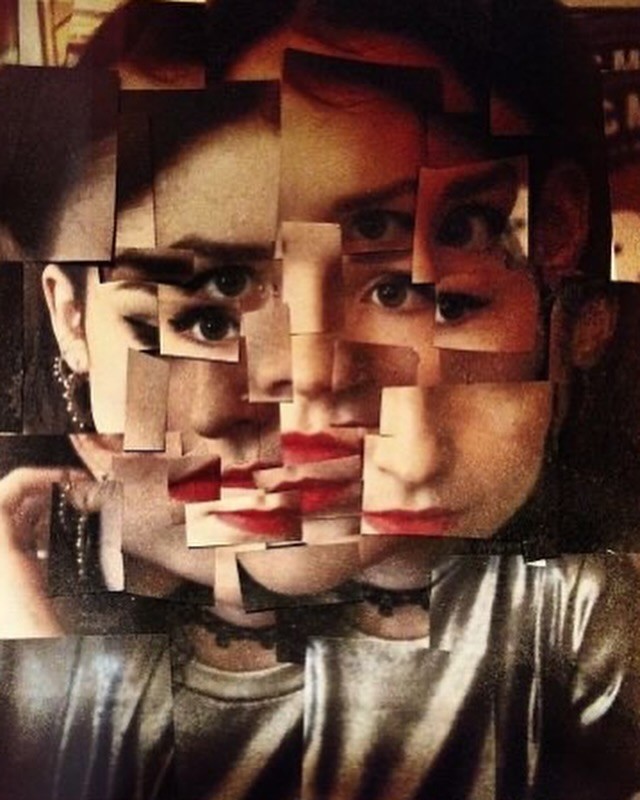
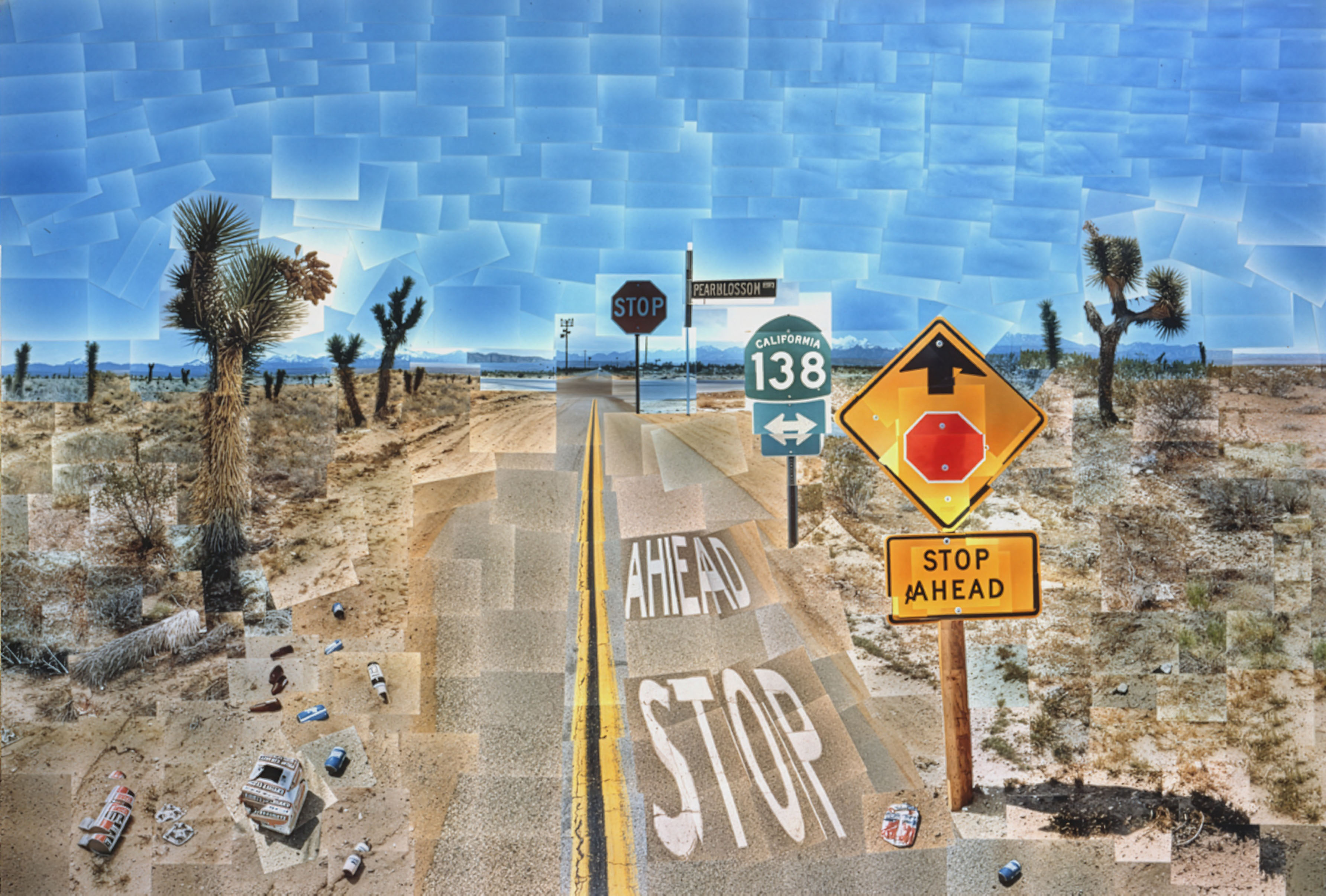
There is a photograph hanging in the Getty Museum in Los Angeles that is not a photograph. It is 198 x 282 centimetres. It is made of Polaroids. Over 400 of them. Assembled by hand onto a backing board. The photograph shows a desert highway in California. You see road signs, a stop sign and dry brush on either side. The sky above is blue. This is the kind of scene you would drive past on a road trip and forget by the petrol station. You would not forget this one.
The edges do not line up. The sky changes shade from one Polaroid to the next. The road shows up twice, from different angles, at different times. Seams run through the whole thing like cracks in a vase. But instead of looking broken, it feels more real than any perfect, seamless photo of that road ever could.
The piece is called Pearblossom Highway, 11-18th April 1986 #2. The manThe piece is called Pearblossom Highway, 11-18th April 1986 #2. David Hockney made it. He was a painter first. Picked up a camera, got frustrated, then spent nine days in the California desert proving cameras wrong. What he made changed what it means to photograph something. Whether he meant to or not. The camera lies about.
A photograph is a dishonest object.
because it has been edited or added filters or angles, or flattering light. Though all of that is true. A photograph is dishonest at a more fundamental level. It pretends that one moment from one fixed point in space is the truth of a scene.
That is not how you see. That is not how any of us sees.
When you walk into a room you love, you do not experience it in one frozen frame. You look left. Then up. Your eye catches the light on a surface. You look back at the person you are with. You build the room in your memory from all of it. Layered. Shifting. Accumulated over time.
A photograph captures none of that.
It captures one moment. What the French photographer Henri Cartier-Bresson called the decisive moment. That singular instant when the geometry is right, the light is right, something true is happening. One perfect frame. Everything else was a mistake.
For decades, that idea was basically the religion of photography.
David Hockney thought that was nonsense.
The man who got angry at his camera
David Hockney is primarily a painter. Known for swimming pools, portraits, and a particular way of seeing California light. He is not who you would expect to start a revolution in photography.
But Hockney had a problem with the single frame.
He had been using a camera as a reference tool, shooting scenes he would later paint. He kept noticing the same thing. The photographs felt wrong. technically fine. the kind of photo you'd take and never look at again. But they felt lifeless
His conclusion: a photograph shows you what a scene looks like. It does not show you what it feels like to be in that scene. A painting could compress time, shift perspective, and hold multiple truths at once. Because a painter looks left and right, returns to the canvas for hours, builds the image the way an eye actually builds a view. A camera was locked. One position. One moment. One lie dressed up as truth.
So around 1981, he started doing something different with his Polaroid camera.
Instead of one photograph, he would take many. He would move. Change his angle. Come back later in the day. He would print each Polaroid and arrange them by hand on a large board. Overlapping edges, leaving seams visible. Assembling a picture that captured not one moment but many. A scene is built the way memory builds it. From fragments stacked on top of each other.
He called them joiners.
The art world did not know what to do with them. Were they photographs? Collages? Paintings? Hockney said: does the label matter? They are more honest than any of those things alone.
Before Hockney, there was a Dutch mountain that did not exist.
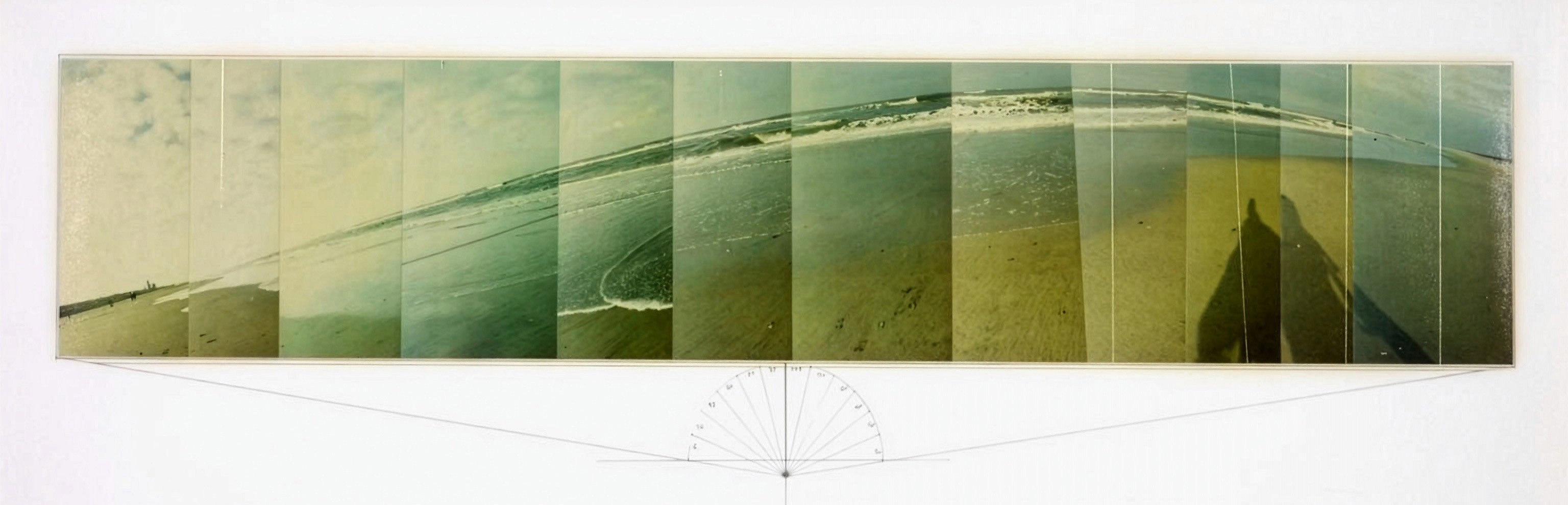
In 1971, a Dutch artist named Jan Dibbets made a series called Panorama Dutch Mountain.
There is no mountain in the Netherlands. That is a flat country. A panorama of a Dutch mountain is, by definition, a photograph of something that does not exist.
What Dibbets actually did: he set his camera on a tripod in a field, shot a frame, rotated the camera slightly, and shot again. Working his way across the horizon. Then he arranged the prints in a sequence, each one slightly misaligned from the last.
The result looked like a mountain. Built from camera rotation and assembled frames, not from anything that was actually there.
It was a prank. A philosophical provocation. A question disguised as a landscape: what is a photograph actually showing you?
Dibbets was not calling it panography. Nobody was calling it anything yet. But the idea was there. Assembling multiple frames into one image, keeping the seams, refusing to pretend the picture was seamless when it was not.
It just needed someone with enough fame and enough Polaroid film to put it in front of the world.
From panorama to panography and why that gap matters
Panography does not exist without panorama. So it is worth understanding what panorama was and why it was never quite enough.
The word comes from Greek. Pan meaning all, and horama meaning view. All the view. Everything at once. The desire to see more than one frame could hold is genuinely ancient. Cave paintings stretched across rock walls. Medieval tapestries depicted entire battles in one horizontal sweep. People have always wanted to see more than what was directly in front of them.
When cameras arrived, the obsession continued. Photographers assembled multiple exposures side by side, stitching scenes that no single lens could capture. The seams were visible, the joins clunky. But visible seams were always understood as a problem to be solved. The goal was seamlessness. The ideal panorama was one where you could not see where one frame ended and another began.
Your phone's panorama mode is the direct descendant of this thinking. Pan slowly, and it stitches the frames into one unbroken image. Seamless. Clean. One continuous lie.
Panography is a panorama with its seams showing.
That difference sounds small. It is not.
A seamless panorama says: this is what was there. Panography says: This is how I assembled what I saw. One hides the construction. The other puts it in the frame. And the one that admits it was made, counterintuitively, feels more real.
German photographer Mareen Fischinger made this clear when she began her Panography series in 2009. Working digitally, she would photograph city scenes for over 30 minutes and assemble hundreds of frames into one wide image. Her Times Square panograph shows the same pedestrian crossing the same intersection three times. A taxi is arriving. The same taxi is leaving. Thirty minutes of a city, all visible at once.
It does not look like a glitch. It looks like what Times Square actually feels like. Layered, relentless, everything happening everywhere at the same time.
She named the genre. The name stuck.
The people who built it
Every movement has its characters. These are worth knowing.
David Hockney. The painter who believed cameras lied and spent nine days in California proving it. His argument was not really about photography. It was about perception. How human beings actually see versus what cameras claim to show. The joiners were a statement. Your single frame is a lie. Here is the proof.
Jan Dibbets. Quieter. More conceptual. Less interested in making you love the image and more interested in making you question what you are looking at. His Dutch mountain exists only as an idea. That was enough for him.
Noel Myles. Probably the most obsessive practitioner. He would shoot thousands of frames of a landscape and spend months assembling a few hundred of them into one image. Dense, painterly, patient. He won the Bradford photography prize in 1987. The judge was David Hockney. Of course it was.
Mareen Fischinger. The one who brought it fully into the 21st century, added time as an explicit dimension, and gave the whole thing its name. Her cities feel alive in a way archival work never does.
And then there is Andreas Gursky. A German photographer famous for massive, hyper-detailed images of supermarkets, stock exchanges, and rivers. Assembled digitally from multiple exposures but aimed at seamlessness rather than visible seams. His Rhein II sold for 4.3 million dollars at Christie's in 2011. He does not call himself a panographer. But the method, assembling many frames into one image and presenting it as a single view, is the same philosophical territory.
Gursky is panography hiding its seams again. Which means the whole technique exists on a spectrum. From Hockney, who wants you to see every single join, to Gursky, who wants you to forget any joining happened at all. The interesting work tends to live somewhere in the middle, where you can feel the construction even if you cannot quite see it.
How it is evolving today
Panography, as a formal art practice, is still niche. You will not find it in every gallery or every design portfolio. But the thinking behind it, showing construction, layering time, assembling rather than just capturing, is everywhere now.
On social media, photographers share joiner-style work under #panography and #photojoiner. Mostly digital, often shot on phones, assembled in Photoshop. Niche enough to feel interesting and accessible enough for anyone with a camera and a free afternoon.
In immersive media, the parallel is difficult to ignore. VR panoramas, which are 360-degree images made from multiple exposures, are doing technically what Hockney was doing with Polaroids. The technology is completely different. The idea is identical. Google Street View is, in a sense, a panograph of the entire planet. The seams are hidden now because technology has got good enough to make them invisible. But the construction is still there.
In brand design, which is where I work, panographic thinking has applications that are not being explored nearly enough. A brand visual system is a set of decisions about how to present one organisation across many surfaces, many moments, many contexts. You are assembling many views into one impression. Whether the seams should show is a genuine brand strategy question, not just an aesthetic one.
Some brands want total seamlessness. Every touchpoint matching exactly, smooth and consistent but slightly inhuman. Others let the seams show a little. The brand admits it was made by someone with specific intentions. That honesty becomes part of the identity.
The most interesting brands are usually the ones that let the seams show.
What Hockney was actually saying
Hockney spent nine days on a California highway. He took over 400 photographs. He assembled them by hand onto a board. The result was 198 centimetres wide and now hangs in the Getty Museum.
He did not do that because he thought it looked cool.
He did it to make a point. One frame is not enough. Not enough to show the truth. Not enough to capture how it feels to stand somewhere and actually look at something. One frame is always a reduction. Always partial. Always presenting as complete something that is fundamentally not.
Panography says: What if we stopped pretending?
What if we showed the construction? What if we made the seams honest instead of hiding them?
The surprising thing, the thing that still gets me when I look at Hockney's work, is that the honest version is more beautiful.
Not despite the seams. Because of them.
Panography is what happens when you photograph the same scene from different angles at different moments and assemble it without hiding the joins. The seams stay visible. The fragments stay fragments. And somehow the broken version tells you more about the place than any single clean frame ever could.
It is older than you think. It was named by a German photographer in 2009. It was argued for most passionately by a British painter who believed cameras lied and spent nine days in a California desert proving it.
It matters because it asks a question we are not always comfortable with.
What are we hiding when we make the seam invisible?
And what might we gain by letting it show?
The camera shows you one moment. Memory shows you all of them, stitched together imperfectly, the joins visible if you look for them.